
CTEK vs. OptiMate: What the Numbers Actually Say

At events like Goodwood, we hear the same question again and again: "CTEK is the name I know from cars — why should I choose OptiMate instead?"
It's a fair question, and it deserves a fair, fact-based answer. Below, we break down three things that actually determine how good a battery charger is — deep-discharge recovery, standby power draw, and true charging efficiency — using publicly published specifications and simple math anyone can verify.
01 How Low Can It Go? Deep-Discharge Recovery
The first and simplest difference: how flat a battery can be before the charger can still bring it back.
Shown as share of the 0–12V range a lead-acid battery spans from fully dead to healthy. CTEK's 2–4V figure reflects the minimum starting voltage required by most models.
In practical terms, this means a battery that's been sitting dead for months — too far gone for many "smart" chargers to even recognize — can often still be recovered by an OptiMate unit. That's not a marketing claim; it's a function of the charger's detection circuitry and starting algorithm.
02 Standby Power Draw
A charger left plugged in — whether it's between maintenance cycles or the battery has been disconnected — still pulls power from the wall. Regulations in most markets now require this idle draw to be under 0.5W, and OptiMate is built to meet that.
The honest way to compare chargers here isn't a vague "we use less power than the competition" — it's putting the actual measured standby wattage of comparable models side by side. We'll be publishing model-for-model standby draw figures so customers can see this for themselves rather than take our word for it.

03 Charge Effectiveness: The Number Almost Nobody Talks About
This is the big one, and it's where the most confusion — intentional or not — happens in the industry.
Many manufacturers advertise "efficiency" based only on the internal converter's efficiency (how well the electronics inside the box convert power). That's a real number, but it's not the number that matters to your wallet or the environment. What actually matters is:
Here's why the gap between those two numbers can be large.
Power In: Why "Amps Drawn" Isn't the Whole Story
At home, your meter measures the amps you draw at a fixed voltage — that's what determines your bill. But here's the catch: AC equipment doesn't always use the power it draws efficiently.
Current and voltage in AC power are two waveforms. Ideally, they're perfectly in sync — that's called a "power factor" of 1. If a device's internal circuitry causes the current wave to lag or distort relative to the voltage wave, its power factor drops below 1, and it needs to draw more total current to deliver the same amount of usable power.
- A device with a power factor of 0.5 is only putting 50% of the power it draws to actual use — the rest is wasted as heat, even though you're billed for all of it.
- Only chargers with Power Factor Correction (PFC) circuitry keep that current wave in sync with the voltage wave, pushing the power factor toward 1 and minimizing that waste.
Power Out: The Easy Part
DC output has no waveform distortion to worry about — it's simply:
A Direct, Model-for-Model Comparison
Using each brand's own published specifications:
Figures above are based on each manufacturer's own publicly available product specifications at the time of writing, and reflect straightforward VA/Watt calculations. We encourage customers to check current published specs for both products before making a purchase decision, as specifications can change between model revisions.
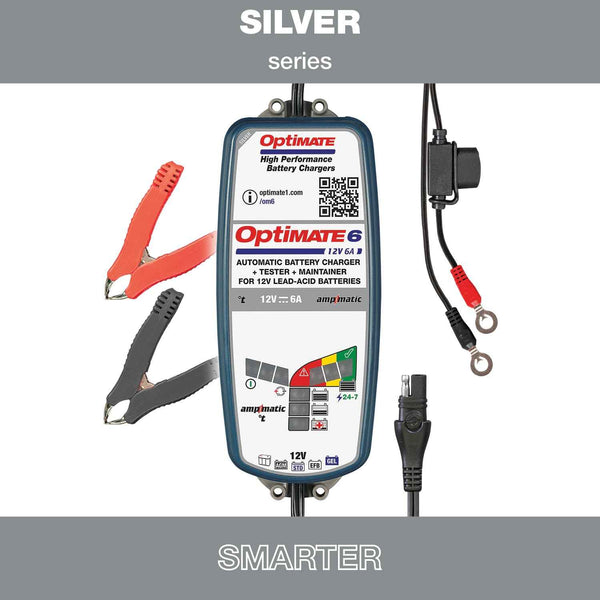
OptiMate 6 Ampmatic : SILVER series 12V 6A lead-acid battery saver, charger, tester & maintainer
$135.99
Shop Now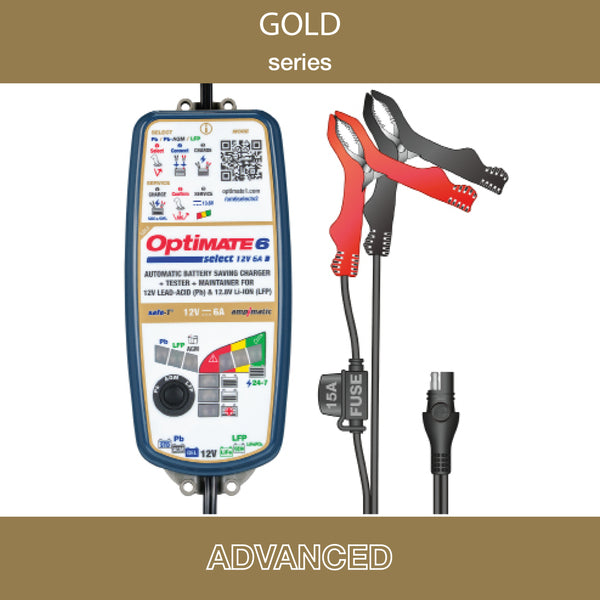
OptiMate 6 Select v2 Gold Series: 6A 12V Automatic Battery Saving Charger, Tester & 24-7 Maintainer
$145.99
Shop NowWhat This Actually Means
The OptiMate 6 delivers 1 more amp of charge current than the CTEK XS 5.0 — while drawing roughly 35% less power from the wall to do it (86.4VA vs. 132VA).
Put another way: the OptiMate 6 is nearly twice as effective at turning wall power into battery charge as a comparable unit without power factor correction.
That's a lower electricity bill for the same job — or a faster charge for a similar bill — depending on how you look at it. Either way, it's a difference you can measure, not a marketing slogan.
Why This Matters When You're Choosing a Charger
If you're comparing battery chargers — whether for a car, motorcycle, boat, or powersports battery — three questions are worth asking about any charger, OptiMate included:
- How low a voltage can it recover a battery from?
- How much power does it draw when it's just sitting there, plugged in?
- What's the actual charge effectiveness — power delivered to the battery divided by power drawn at the wall — not just the internal converter efficiency?
Ask any manufacturer for these three numbers. If they can't answer clearly, that itself tells you something.
Frequently Asked Questions
What is "charge effectiveness" in a battery charger?
Charge effectiveness is the percentage of power drawn from the wall outlet that actually reaches the battery as usable charge. It's calculated as power out (Amps × Volts, DC) divided by power in (Amps × Volts, AC), and it accounts for power factor — something converter-only "efficiency" ratings often ignore.
Why does power factor matter for a battery charger?
Power factor measures how in-sync a device's current draw is with the AC voltage waveform. A charger with poor power factor draws more total power than it actually uses, wasting the difference as heat — while you still pay for the full amount drawn.
How low a voltage can OptiMate recover a battery from?
OptiMate chargers are designed to detect and begin recovering batteries from as low as 0.5V, compared to the 2V–4V minimum starting voltage required by many competing "smart" chargers.
How does the OptiMate 6 compare to the CTEK XS 5.0?
Based on each brand's published specifications, the OptiMate 6 delivers 6A of charge current using 86.4VA of input power (83.3% charge effectiveness), while the CTEK XS 5.0 delivers 5A using 132VA of input power (45.5% charge effectiveness). The OptiMate 6 delivers more charge current while drawing roughly 35% less power to do it.
How much power does a charger draw in standby mode?
Regulations in most markets require chargers to draw less than 0.5W when idle (plugged in but not actively charging). OptiMate is designed to meet this standard.
Have questions about which OptiMate model fits your battery? Contact our team or explore the OptiMate 6 and OptiMate 7 product pages for full specifications.